



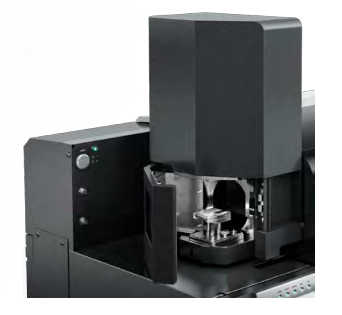


Shimadzu Corporation announces the release of its Thermal-damaged plastics library, a collection of specialized data for qualitative analysis of plastics that have deteriorated due to heat. It is designed for use with Fourier transform infrared (FTIR) spectrophotometers, which are widely used to qualitatively analyze unknown samples.
The library was compiled by Shimadzu Corporation from spectra measured and acquired by the Hamamatsu Technical Support Center, Industrial Research Institute of Shizuoka Prefecture. The library includes data from 111 spectra obtained from plastics deteriorated by oxidation due to heat, making it especially useful for directly qualifying heated plastic samples. It can also be used for analyzing contaminants, substances that cause defects, and other unknown samples.
Background to the Development
Plastics are used in a wide variety of applications, including parts, films, fibers, coatings, and adhesives, but are also contained in contaminants and other substances that cause defects. In many cases, such plastics have deteriorated due to the effects of heat. One technique typically used to identify defect-causing substances in the quality control departments of manufacturers or contract testing institutions involves qualifying substances by comparing their FTIR spectral data to FTIR spectral data in a library. However, the spectral data contained in typical libraries is measured from non-deteriorated materials, which makes it difficult to qualitatively analyze substances that have structurally changed from oxidation due to heat.
In contrast to standard libraries, this unique Thermal-damaged plastics library contains spectral data for heated plastics, making it much easier to identify spectra that significantly differ before and after heating. In addition to expanding sales to contract testing laboratories and quality control departments of manufacturers in fields that routinely analyze contaminants, such as the processed food, petrochemical, automotive, and consumer electronics industries, we also intend to develop new applications that involve analyzing unknown samples, such as at crime laboratories.
Features
- Contains spectral data for heated plastics, which can be directly compared to spectra from actual samples.
- Establish a system more suited to qualitative analysis by adding libraries.